5 min read
Business dinner in Budapest, in a great location
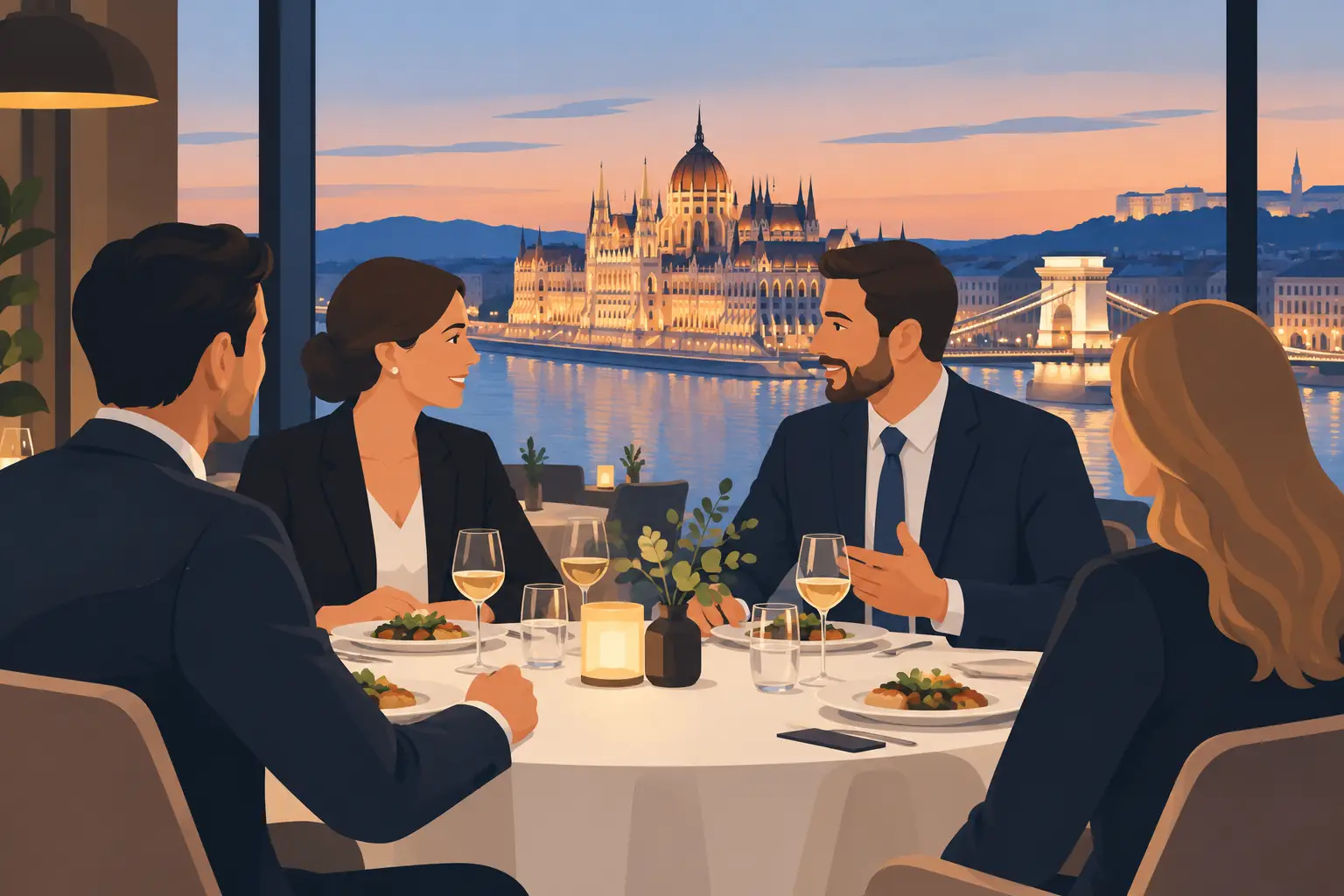
Behind a search for "business dinner Budapest" there is rarely just a desire for a restaurant. It could become a first meeting with a new partner, a team dinner after a closed project, or a longer discussion that you would rather not continue across a conference table. In such cases, a good venue does not distract, but rather provides a natural framework for conversation: easily accessible, predictable, and vibrant, yet not overly noisy.
There are many restaurants in downtown Budapest, but for a business occasion, the rhythm of an evening makes all the difference. A dinner will be memorable for the right reasons if there is no unnecessary uncertainty from arrival to dessert. Italian cuisine is a particularly great partner in this: approachable, shareable, yet elegant enough to suit more serious conversations as well.
What makes a business dinner work in Budapest?
The first aspect is location. For a downtown dinner, it matters greatly that guests can arrive comfortably after work, and those coming from different parts of the city do not have to make long detours. The area around Districts V and VI is therefore a practical choice: it is close to offices, major transport hubs, and serves as an urban meeting point that is easy to navigate even for international partners.
The second is atmosphere. In an overly formal restaurant, the conversation can become stiff, while in an excessively noisy place, you have to fight for every sentence. A good business dinner is not a protocol dinner, unless the occasion specifically calls for it. It is rather an evening where those seated at the table pay attention to one another, and the food comfortably supports the gathering.
Third is predictability. If you are inviting your partners or colleagues, it is important to know in advance what kind of dining model, approximately what cost, and what kind of experience they will arrive to. This is not an argument against spontaneity. Quite the contrary: it is alongside solid foundations that one can engage in truly relaxed conversation.
The occasion determines what kind of restaurant to choose
Not all business dinners are the same. A two-person partner meeting requires different attention than a team-building dinner for ten. It is therefore worthwhile to choose not just a restaurant, but a type of dinner.
An à la carte rhythm suits a partner meeting
If the goal of the dinner is to lay the groundwork for a new collaboration, get to know an important client, or continue an executive discussion in a calmer setting, à la carte dining is usually more natural. Everyone chooses at their own pace, and the table is not about consumption, but about attention.
Italian dishes work well here because they are familiar and adapt to a wide variety of tastes. Carefully prepared pasta, pizza baked in a real wood-fired oven, or a lighter appetizer require no lengthy explanation. Yet they have character, especially when the ingredients are genuinely fresh and the preparation is also visible.
Our Ape Regina Di Piazza restaurant on Vécsey Street has permanently closed. We welcome our guests at 18 Podmaniczky Street, where they can choose between All You Can Eat & Drink and à la carte dining.
A clear framework is an advantage for a team dinner
With a larger group, the dynamics are different. Here, the question is not necessarily who chooses what from the menu, but whether everyone can comfortably find their favorite, and whether the organizer needs to constantly manage the bill, orders, or the pace.
A fixed-price, unlimited All You Can Eat & Drink setup can be a strong solution in such a situation. It sets a clear framework for costs, while allowing the group to choose more freely. It works particularly well for an after-work team dinner, a year-end occasion, or when the goal of the dinner is not to finalize a single negotiation point, but to spend time together.
At the Podmaniczky Street location, this more relaxed, generous format also meets the option of ordering à la carte. This is practical because preferences within a group are not always identical either. Some may want to taste several courses, while others prefer to focus on a single favorite dish. The right choice depends on what the team is like, how much time is available, and what kind of evening you would like to have.
Quality should be visible, not just a promise
In business hospitality, food is not merely background scenery. It does not need to be the main star, but it says a lot about the care with which the host chose the venue. That is why details that can be perceived with the eyes in a restaurant hold significance.
An open kitchen, for example, is not just a visual feature on its own. It builds trust: guests see the work, the preparation, and the rhythm of plating. Fresh pasta kneaded by hand daily and a wood-fired oven are foundations that require no overcomplicated story. They can be tasted in the food, and they add something to the dinner's atmosphere of that genuine Italian hospitality one is accustomed to in Italy.
Both dining styles are available in one place, at Ape Regina on Podmaniczky Street. Unlimited tasting suits hearty, social occasions, while with à la carte ordering, everyone can compose their dinner from the menu. The culinary foundation is the same in both cases: fresh pasta, a genuine wood-fired oven, and direct Italian hospitality.
What should you pay attention to before booking?
First, clarify with yourself the true purpose of the dinner. If an important decision needs to be prepared, it is worth choosing a table and a time when the conversation can proceed peacefully. If you want to thank or bring the team together, a more casual dinner built around sharing can offer more than excessive formality.
Group size and dietary requirements also matter. For a larger team, it is especially useful to consider in advance whether there will be vegetarian guests, food sensitivities, or a colleague who can only join for a shorter time. There is no need to turn the dinner into an administrative task, but a few details beforehand will help everyone arrive feeling more relaxed.
Finally, do not underestimate the importance of timing. An early dinner fits into a tighter schedule, whereas at a later table, that moment where workplace roles fade slightly into the background develops more easily. The best business dinners do not necessarily produce all decisions immediately. Sometimes it is enough to create that pleasant, thoughtful evening from which it will be easier to continue the conversation the next day.